Monday, March 16, 2020

Mobile Klean

Could Mobile Klean be the answer for COVID19?

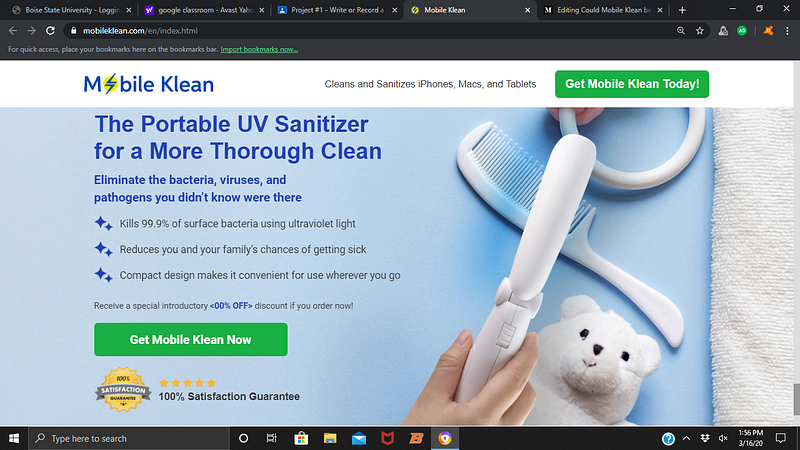
     Introducing Mobile Klean. The answer to the most recent (and current) pandemic. This new virus that is spreading rapidly is quite the scare and is keeping people indoors. This new technology will allow you to keep the disease out of your home. 

     “Mobile Klean is a germicidal sanitary device that uses UV-C light to eliminate the threat of bacteria, viruses, mold spores, and allergy-inducing microorganisms found on the items closest to you” (Mobile Klean, 2020). The light is so powerful that it will essentially exterminate all germs that are present. Since resources and cleaning essentials are flying off of shelves, people should really look into buying this up and coming piece of technology.
                             https://images.app.goo.gl/pAXWGnaMhg9b9fH68
     The amazing thing about this type of tech is that it is portable and can easily be used on multiple surfaces. Most people think that when they come home, they are returning to safety and cleanliness. That is in fact inaccurate. Often times it is your own electronics and appliances that are most contaminated with germs.

     In this time of “quarantine” or “self-quarantine”, people will often turn to electronics such as television or gaming consoles to keep them busy and entertained. This could be dangerous. It is imperative to clean and sanitize the appliances and electronics that you use most around your house. The Mobile Klean will exterminate these nasty germs that you distribute throughout the house. 
What is so special about the Mobile Klean is that it will actually show you where your germs are hiding. Cleaning with a wash cloth or Clorox wipes will only give you the satisfaction of THINKING you are cleaning the surface fully, however, this new tech will assure you that all germs will be evaporated. 

     Mobile Klean is the way to go. Keep yourself healthy and happy this season while we deal with this new virus. Even Mr. Clean is using it! 
https://www.mobileklean.com/en/index.html?fomo=1&Affid=3248&s1=&s2=EAIaIQobChMInKnm_Lad6AIVix6tBh040g1aEAAYASAAEgKeNvD_BwE&s3=&s4=1913&s5=c416e555279b4334afded48eea7a6811&domain1=www.flrdra.com&network_id=69 

Sunday, October 27, 2019

 my technology that i wanted to talk about is the new apple watch 5 serious. this is the best watch out as of now. costing 399.99 plus tax will get you a brand new apple watch. some of the cool things about this watch is that there are a few new features about it and things you can do with it. the first thing is two new case materials one is bright yellow and the second one is titanium. some more things you should know is that the S5SOC stands for system on chip and what that is different components that is on the chip. the next thing is the compass it has latitude and longitude. and the creative thing about this watch is you have the apple store on it so now you can download app from your watch. this is a great watch to have and that's why i chose this for my new technology   

Saturday, December 1, 2018

November Blog Post

We did a group activity in class that was exciting. We demonstrated negotiation and collectively discussed our views. We talked about what supplies we would prioritize. Some of us wouldn't change our views on certain things and on other things we did. I thought that it was pretty funny what some people prioritized and I was also very interested why people prioritized this over that and that over this. We all had a good laugh when we talked about prioritizing water over oxygen haha! I think that its important to do activities like these because it forces you to think logically and that is challenging for me to do which means its healthy for my brain. I can use critical thinking and prioritization in every day life. I think that many of us don't realize why its important to do exercises like this and, for me, its fun sharing and discussing opinions and views about what I think is more important between two things whenever the discussion is a few notches under politics, of course. I enjoy doing in class activities and visually learning because that helps me so understand concepts much better. When we did the yarn activity it made myself, along with others, cognizant of how much more and less we talk than others. It's very important to listen to people and that activity reinforces active listening. I think that you have kept the class engaged this semester by having us discuss in and out of our groups. It makes class more fun and also makes me want to pay more attention in class. I understand that the entire class couldn't revolve around talking with fellow classmates, but I selfishly wish it did haha! In the end I understand we are here to learn and I'm glad that we do get to have fun in class because in most of my other classes it is very boring every time. I appreciate that you put effort towards engaging with everyone because it makes a difference and that's what separates a good professor from a great one. I think that you are such a genuine person and I can tell that you have a true passion for a lot of things which is more inspiring than you know. I can definitely say that your class has been very fun and I can't express that enough.

Tuesday, November 27, 2018

October Blog Post

Impression management is how we see and present ourselves. It is the way we communicate and the artifacts that we choose to express our self image. I would say it is a lot like using social media. One is completely in control of their own appearance and actions but not of the other users. How you choose to move forward with your image is a lot like the actions that you choose in life. You can control almost everything about yourself but nothing about how others see you. You can change things about yourself in hopes that people will see you a certain way. I think in social media the biggest part of impression management is the control people have over it. You can put things up to make your life look a certain way. Also, you can delete things and people or their interactions that you feel take away from your overall "image". I feel like our need to use impression management with social media comes from the emphasis on image in society. There are so many ads focused on image and so many celebrities that are constantly sharing their image and artifacts.

Monday, November 12, 2018

Blog #3

The topic that I chose for this week’s blog post is the concept of rituals. Rituals are recognizable patterns that inform/guide our interactions. We see these rituals in family relationships, friendships and romantic relationships in our everyday lives. For example, with the holidays coming up there are many rituals that take place within relationships. Things as small as baking cookies or eating holiday dinner together are rituals. We act out these rituals because it is a part of our culture, and every culture for that matter. Communication is a type of ritual, whether it is talking, sign language, body language or even signals. These are rituals in everyday life. However, let’s talk about rituals in media. I chose a movie called “A Quiet Place” which is a horror movie about a family of five who need to stay quiet their whole lives. They stay quiet to avoid the monsters due to an apocalypse. Their family ritual is to stay quiet and use sign language and signals as a form of communication in order to survive. They do that to stay together and have learned it over time. This is because some rituals take time to learn and some come about right away.

Saturday, November 10, 2018

October blog post #3

Autoethnography

Definition:
The use of personal experience to categorize, critique, and examine cultural experiences.

Elements of Autoethnography:
  1. Purposefully communicating your opinion or thoughts about a culture or culture practices.
  2. Making contributions of your personal findings to existing research made about a culture.
  3. Practicing vulnerability in order to have a open mind with all culture in order to expand your knowledge and understanding about a particular culture.
  4. Creating and achieving a relationship with your audience in order to encourage others responses and opinions about your findings or about another culture.

Importance of Autoethnography:
Autoethnography I consider to be a good thing as long it is practiced appropriately and with caution because there is a close line to stereotyping that can arise if one doesn’t practice having a open mind with this skill. For example, someone may have had a bad experience with a certain culture and they begin to personally dislike that culture and close their mind to any other possibilities about them and begins to hate and slander that culture to others in society. However, autoethnography is beneficial to society  because a lot of facts we have about cultures is based off of people’s findings and opinions on cultures. It also allows us to have a wider understanding of a culture through a wide range of people’s attributions about cultures.

I consider this a lot like politics. People’s opinion and suggestions play a heavy impact of others in society throughout the public. That is why we must fact check everything you read and choose to believe to make sure following information is factual based or personal based. As long as you follow the elements of autoethnography and practice this skill appropriately you will succeed in developing this skill.

Friday, November 9, 2018

Mediate Cultures- October Blog Post


     It is vital to analyze the relationship between media and culture so that we can check the influence that media has over our own perception. As we were taught in class, "media shapes our ideas in culture"(Ivey, 2018). This happens through two avenues, co-construction and representation. Co-construction is the idea that "we use and create media even as media uses and creates us" (Ivey, 2018). Co-construction is about the symbiotic relationship between us and the media; we create media for the public to consume, we consume that media, and it informs our ideas, which then forms our society. The media that we take in molds our view of the world around us, which makes the media extremely powerful. The second way that media influences culture is through representation. The people or groups of people we see represented in media, and the way that they are represented, determines the way that we view people in real life. Seeing all kinds of people represented in the media in all different ways reduces prejudices and increases empowerment. When people are exposed to lots of different representation in media, their perception is shaped from that media and they treat people better. If representation is low in the media, and they only show one kind of person, people will be less tolerant of anyone that isn't the same as what they see in media. This shows the sheer power of media on the way that we see the world. 
     My grandparents are baby boomers. Being a part of that generation, they did not grow up with the wide expansion of technology that we have now. Their perception was shaped by the limited media they had growing up, which was radio, limited television, and the newspaper. Being from rural Wyoming, their geographical positioning in the world limited the representation that they saw in the media growing up. So, the media that they were exposed to until their late 50s and now into their 60s has been very consistently homogenous. Now, they have an iPad and my grandmother has an iPhone. They use Facebook and Twitter. Since they did not grow up with technology that allows for the spread of all kinds of ideas from any person at all, and because their ideas have already been shaped by their lack of exposure to representation, they are susceptible to misleading information from the internet. They never learned the skills they need to vet information before they believe it, and they already have preconceived notions about any group of people that doesn't look or think like them from lack of exposure to anyone "different". This inability to fact check information, along with previously developed prejudices has turned their lives on social media into an echo chamber of conspiracy theories. The media that they consumed has shaped their perception of the world in a big way, and there is no way to really fix that because they won't believe anyone outside of their idea of trust worth media. 
     I think awareness of how media shapes culture is vital. If we don't know this, we can allow media outlets to influence our culture without anyone to check if what they are saying or doing is right. My grandparents aren't equipped with the skills they need to ensure that their media consumption is ethical, but my generation doesn't get that excuse. 

Ivey, C. (2018). Mediated Cultures [Prezi presentation]. Retrieved from https://prezi.com/sq-j4vjhd2ks/mediated-cultures/?utm_campaign=share&utm_medium=copy 

Wednesday, November 7, 2018

October post


The most important thing that stood to me during the month of October was the lesson and video about Disney.  It really made me reflect on the movies and shows I grew up watching. I personally never noticed the racism that was portrayed in Disney movies, but after it was pointed out in the film I knew what they were talking about.  The point in the film that stuck out to me the most was the little boy who was scared by children because their voices sounded like the monkeys from a movie. I do not remember exactly what the situation was. I was surprised that a child picked up on that because it was is not something that ever crossed my mind as a child.  I think it is important to know that these movies can shape the way kids view people. With that said, I think Disney has done a great job with their newer movies. For one, not all their movies revolve around princesses. They have other plots other than falling in love. Also, Princess Tiana made a change in the media. She was the first princess to not be white, which made a huge statement.  Moana was also a princess of color, and she did not fall in love in the end. Instead, she got to be the hero and save her whole tribe. Another newer movie is Frozen. This is the only Disney movie to state that you can not fall in love with a man you just met and it is about sisterly love. These movies have helped children be more educated and accepting of other races. Disney is headed in a good direction to become more inclusive.  

October Blog Post


            The concept I have chosen for this month is related to chapter 11, Mediated Culture(s). I wanted to focus more specifically on advertisements and the messages they contain. The reason I chose this is because of the vast number of ads that every person in our culture is inundated with daily. Advertisements are everywhere and we are so used to seeing them everywhere we look that we sometimes don’t consider the social context behind the product. People unconsciously absorb ads and they in turn have an influence on our worldly perspective. They impact what we consider societal norms, they help shape our ideas about gender roles, body image, they often reinforce stereotypes and inadvertently promote things like sexual violence. Often ads are run that just shouldn’t be and while this issue is starting to gain more attention than it has had in the past, it still widely goes unnoticed. 
            I had a professor at a community college years ago who had us do an exercise where she brought hundreds of magazines to class. The magazines were all diverse in type from fashion, to outdoors, to gardening and homecare. She told us to pick 10 out and cut out any articles that we think may have a social message that goes deeper than the product the company was selling. This exercise stuck with me because we found all kinds of crazy ads, particularly in the fashion magazines that pretty clearly promoted things like sexual violence. There was a great example in a 2015 Bloomingdales Christmas ad, where there is a man creepily staring at a woman while she is looking in a different direction smiling and laughing with a caption between them that says, “SPIKE YOUR BESTFRIEND’S EGGNOG WHEN THEY’RE NOT LOOKING”. http://www.bandt.com.au/media/bloomingdales-christmas-ad-accused-of-promoting-date-rape . The ad was withdrawn and an apology statement was issued by the company for unintentionally promoting date rape. This is one of many examples that can be found, and unlike this one that was so obvious, many of these ads get overlooked.
            With ads being so prevalent an unavoidable in our society, it is important that we are aware of the impact they have and the messages they convey. With better understanding we can hold companies more accountable for the content they put out, and we can even use these ads as a learning tool of what not to do. I believe it is important to teach people about the impact media has on our culture because we live in a diverse culture and we should be putting out the right kind of messages to all.

Tuesday, November 6, 2018

Fallon Falore
Christina Ivey
COMM 160
6 November 2018
“The Most Important Sentence”
The focus for my blog post this month is going to revolve around media and its effects on society. Specifically, through Disney movies and their effect on children as they grow up. When you are young, you don’t realize that these movies are teaching us lessons of all kinds. Although not all lessons in Disney movies are necessarily bad, there is definitely an imbalance of positive to negative lessons that children grow up learning. This is due to the overwhelming amount of discrimination throughout each one of Disney’s movies. A few of the discriminatory aspects that the movies cover are racism in Dumbo and sexism within Beauty and the Beast and The Little Mermaid.
According to Dictionary.com, Racism is when “prejudice, discrimination, or antagonism directed against someone of a different race based on the belief that one's own race is superior”. As much as we hate to see it, Disney movies are covered in racist themes in the characters that easily go over any child's head. According to ScreenRant, a youtube film, the 1941 film Dumbo showed racist themes in the characters. The black crows resembled members of the African American culture and the stereotypes around the culture. They resembled the stereotypes in this culture by giving the crows heavy accents, making them jazz singers, and having them smoke. Moreover, the main crow was named “Jim Crow,” after the state and local laws that reinforce segregation. As you start watching disney movies when you get older or looking back on them, these motifs were hidden behind the joy and song. Often times media gets a reaction from the people, but you wouldn’t expect such negative reactions from a children's movies that made us so happy growing up. Since, children are unaware of these life lessons, they see them as normal.
One aspect of Disney movies that has become a completely normal thought within children's minds are they sexist remarks and values. Girls and boys grow up seeing how they should act through the media that they watch. In movies like Beauty and the Beast and The Little Mermaid, gender roles are shown in a completely harsh way. In Beauty and the Beast we see Gaston as they ideal man. We see girls flaunting at him and he is expected to be the strongest, smartest, manliest man there is. This is teaching young boys that they cannot be vulnerable or weak, they have to be one way in order to be wanted by the ladies. This is reinforced again in the music, as well as through his sidekick, Lefou, who wants to be just like him. Lefou is also short, chunky, ugly, and just the assistant to the man. In The Little Mermaid we see Ariel giving up her voice in exchange for legs, so that she will be able to fall in love with this guy. This is teaching young girls that they should give up everything for a guy and do what it takes to get the guy. This is reinforced in a majority of the songs that play throughout The Little Mermaid. This teaches our children to grow up stressing over how they should act and what gender roles they should follow. However our children should not be thinking of these things, they should be living life to the fullest and wondering who their next play date is going to be with.

This is the most important concept to me because I find it insanely crazy that we can have adults making movies and tv shows for children and not realizing the pressure they are putting on them or the thoughts they are putting in their heads. Where kids see lessons of love, adults see racism and sexism. These aspects easily go over the children's head, but they don’t realize that the constant viewing of these stereotypes is being normalized in their brain. With that kind of power, I would hope that directors of all kind would use it to spread lessons on compassion, kindness, respect, and all the other amazing qualities that the human race has to offer.

October Blog Post

One aspect of this month that stood out and intrigued me, was the idea that highlights the role media plays in society and varying cultures. Many aspects of the way media influences the younger generation and how they act out, is due to easy access to technology and online media at an early age.
When the children see these "internet stars" & figures on twitter, Instagram, etc., they are seeing this as inspiration to fuel their actions online, as well as in real life. For example, the "Catch me Outside girl," Danielle Bregoli, was first seen on the show, Dr. Phil, in which she disrespected the host, as well as the audience, and her mother. She stormed out of the show after having a negative reaction given to her, and quickly found herself rising to fame, through twitter retweets, and many shares on the internet. Due to this, she maintained her figure and attitude in which she constantly shared on the internet with new found successes, such as song deals and more. The children seeing her disrespectful attitude and actions constantly being practiced, quickly followed in them repeating the same actions day after day online and in real life. They think that this is okay for them to do, because they are given the access to the online world very easily.

October post

For this blog post, I chose advocacy as my concept and more specifically advocacy through alliance building. Advocacy itself means supporting something or someone. Advocacy through alliance building means building a connection in between different groups, which will help getting to the objective in a faster and easier way.  

One of the examples in which I feel this concept is very clear is in politics. When it comes to this topic, there is always going to be people with similar ideas and people with entirely opposite ideas. When elections are close, you can see how groups of people who think in the same way, and want to make the same or at least a similar decision, become really close. It is almost like if  their objective is to proof that their group is right and that everyone should vote for the one person that they think is the best. Another example can be protests, when people are doing this type of activities is because they have the same ideology and want to show it to everyone else. I am sure most of the protests start with different groups of people who have a topic in common and who want to make a change regarding that. The concept can be reflected like this: different people with the same ideas gather together, then different groups with some ideas in common gather together, and by means of doing that, they can obtain whatever they are hoping for in a faster way. Finally, I have experienced this concept myself, it is very hard for me to be close to people who have ideologies that are extremely different than mine, and even more if I have to make a decision regarding that matter. When I was in High School, every year we had a debate to discuss international matter (more specific wars in Asia). I was always against the intervention of the United States in those wars. While having the debates, I would always try to find people who felt the same way and then we created sort of a group in order to make our idea be the right one. This examples for me shows that I liked building connections and supporting ideas because they were similar to the ones I had.

This concept is important because it shows how groups act when they find others who have similar ideas. It is also important because I feel that nowadays we only try to find people who have ideas that are close to the ones we have and based on that a bigger decisions is made and different plans are created in order to make that happen. For me, we still are in a society that is scared of the unknown so it is easier just to get closer to the things that are common to the person and then creating groups that follow the same beliefs. I just think this is a concept everyone has experimented at least once in their lives.

November Post

Recently we talked about family and the structures, values, and behaviors. We talked in class about the typical American family with two parents and 2.5 children. When we think about a typical family we think about dinners together, celebrating holidays, middle class and white picket fence. The difference is that not all families are like this but we still see a typical family as so. Throughout the years we have been told that strong families of the foundation of a society and that bad parents are to blame for social ills. How else are we supposed to think about a family? We’re told time and time again that we need to have a strong family in order to be emotionally mature. Therefore of course we believe that a typical family should be this way. Step parents and same sex parents are not talked about as much because it wasn’t traditional and it is modern. It is crazy to believe that these are not considered typical families. Even those couples without kids are putting up an argument cause people say they are not considered a family.

This topic took my interest because from my experience I have not seen a perfect typical family almost ever. I just think that it is so interesting that I still believe the same of a typical family. Another thing I found interesting was the culture of different families. For example a girl in our class said she was of the Hawaiian culture and her family is huge. Also my best friend is Mexican and her family is also huge and always together. From family to family it can be so different and that’s what I loved learning about.

October blog

October:
       
         This month, one of the most prominent subjects of discussion within class was food culture and its connection to identity. Amongst American culture, it is common for our culture to combine different country’s food with American food and label it “authentic” despite our own take on the other country’s food culture. In this blog post, I will be describing the discussion that was held about food and culture from class, as well as connecting advocacy through education and distinction of taste within two countries. 
As an artifact for this subject we watched an episode of Anthony Bourdain’s “No Reservations” series which exhibited an American’s take on exotic/foreign food. Through his perspective, it become more apparent that American society sometimes has the wrong idea of authentic food, as well as opposing views on delicacy and customs used to serve/sell/cook food.
Within the episode we see a variation of ways that authentic Chinese food differs from American’s version of Chinese food. In China, they do not have strict health codes and standards that they have to meet like American restaurants do. Rarely do we ever see food lying around in the open-air containers being sold to people who pick it up with their bare hands and call it “fresh.” China on the other hand (no pun intended), as we saw in the episode, sold pickled goods by the barrel with little to no worry or constraint to keep them fresh and stowed away for only the employees to hand to the customer. 
Another idea we discussed was the way that food is cooked within Chinese culture and how different it is from our culture. We can trace this back to ancient customs that belong to Chinese culture and their definition of good taste and tradition. Hannah Park, a lifestyle writer for Spoon University, wrote about the distinction of flavors and preferences within Chinese and American cultures. Park describes why we choose to create our own versions of Chinese food that caters to the definition of delicious in America by comparing tastes of both cultures. “Take one bite of shrimp Shumai in Shanghai, and you’ll be floored by an entirely different flavor than the sweet and sour dish that you're used to. American-Chinese food tends to take on sweeter, heavier tones (sweet and sour pork, anyone?) than traditional Chinese food, such as Pào mó (otherwise known as mutton stew), which opt for lighter, more savory flavors. This distinction in flavor can be traced back to the fact that American-Chinese food had to cater to a different audience, and as a result the flavors that we see in fusion dishes today say a lot about our food palate as a country.” Separating one’s view or opinion, while expanding their knowledge of food culture can really open the eyes of individuals who are too afraid to try different or new types of cuisine. That is exactly why I enjoyed watching Bourdain explore a country he had never been to yet still having an open mind about a traditional Chinese delicacy that can be compared to pig slop. (Which of course he enjoyed thoroughly.)
Living in America, diversity of cultures is increasing within our population. Luckily for us, we can experience great differences in taste and culture while still carrying an identity of our own favorite local dishes that remind us of where we originate. Being aware of our differences in taste as well as what is “Americanized” and what is truly “authentic” is a great example of advocacy through education. The more we know about American food along with what our taste preferences are, the more we can learn as a population about the difference in other country’s taste and history. This is so important to teach within a population that might not be as diverse or carry a negative view about a specific country’s food because it is different than our own. Education can open the eyes of those individuals more easily than traveling could. 

Work Cited:
Park, Hannah. “6 Ways American-Chinese Food Differs From Authentic Chinese Food.” Spoon   
      University, Spoon Media Inc., 28 Apr. 2017, spoonuniversity.com/lifestyle/6-ways-american-  
      chinese-food-differs-from-authentic-chinese-food.

November blog post

Social penetration theory is the idea that everyone has three levels to their identity. The way that you allow people to gain knowledge of these layers is self-disclosure. The first of which is the surface level or their mask. This level is their outward portrayal towards the public. Anyone that has access to them or their social media can see the surface level of a person. Often this level is rather fake because it is what that person wants you to think about them. The next level is the middle layer. This is where items like ones ideologies and beliefs reside. It is information that isn’t overly personal in nature but you still probably have to have some type of relationship to know these items of their personality. The last level is the core. In the core resides a persons values and secrets. Only people that are in a close interpersonal relationship will generally have access to this layer. Knowledge of these layers is categorized into depth and breadth. To know a lot about a person(s) surface layers is to have breadth and to know a person down to their core is depth.
I think this is an important idea right now because of the elections happening today as well as the age of social media. There is so much breadth concerning surface level information about people readily available but what do we really know about the people we interact with and elect to public office. We love to surf peoples social media and listen to their campaign ads but often don’t make an attempt to break into the middle or core layers. It seems right now that more people put importance in breadth and “knowing” a lot of different people than having deeper interpersonal relationships.
Moving on from personal relationships it is interesting how easily people fall for surface level information in political ads. To use Idaho political ads for example you will often see people mentioning how much they like to ride horses and keep agricultural jobs in state. Now these short ad’s only allow for surface level but even in events like debates it is hard for politicians to take off their mask and show us who they truly are. I understand this is part of the game of politics and usually a smart thing to do, it is frustrating to me. As someone who values the depth of relationships, I find it hard to accept anything politicians or social media accounts say to me. Attached are some of the ads run by Idaho ads in this previous election.

https://youtu.be/RLcOlM1YLP4


Blog # 3_Interpersonal Communication and Relationship Dialectics


Nicole Boyce
Blog Post #3
November 6, 2018

            In reflecting on this class, the thing that most comes to mind is interpersonal relationships and relationship dialectics. Interpersonal relationships according to this class is defined as “the exchange or interaction that occurs between people who are in an interdependent relationship”. The relationship dialectics are as follows: connection vs. separation, predictability vs. novelty and openness vs. closedness. These dialectics play a role in all our interpersonal relationships, whether it be with a partner, a friend or family member. Connection vs separation and predictability vs. novelty especially come into play in romantic relationships. For me, I think about the start of a new relationship. When two people are in the initial stages of dating there is always an element of surprise (novelty) because everything is new. Once committed to the relationship, it’s nice to settle in and get a sense of predictability. It’s nice to plan on seeing your significant other on a regular basis and know you’ll be in regular communication with them throughout the day. Overtime, the surprise wears off and couples get into a routine. Especially when couples are living together, for most relationships, it turns into the “same old same old”. For my relationship, like many others, it can create conflict. I like to be surprised and want to be surprised, while my boyfriend it very much a creature of habit. He values “predictability” and I  “novelty”. Connection vs. separation is also a source of conflict for many relationships. We want to have a sense of autonomy. We all want to have a sense of independence and ‘self’, though when in a serious relationship, it’s easy to lose a part of our independence as we see our identity blend with that of our partner’s. We want to be connected, while also separated. Personally, I think boundaries play a huge roll in managing this conflict. It’s important to maintain a sense of self by setting up clear boundaries (i.e. not feeling the need to be at your partner’s becking call, maintaining relationships outside of the romantic relationship and getting a healthy amount of ‘me’ time) This can be a struggle, especially in a new relationship but it’s invaluable.
            To keep with the Friends theme, like the videos we watched in class, I found this video from friends that is a perfect example of connection vs. separation. In the video, Rachel confronts Ross about attending an activity, questioning on why he was so insistent on joining her. Ross explains how he just wants to be with her and how he feels like Rachel has been so busy with other things and he wants to remain close with her. In this example, Ross is expressing his need for connection. Rachel explains how she likes to do some things individually and sets up a boundary that this is one of the things she perfects to do separate from him. Rachel is expressing her need for separation at times. Enjoy!

October Blog Post

Well well, goodbye October. How did that happen? Over this last month, we have covered a great deal of information. At the beginning of the month, we discussed the relationship between media and culture. As discussed in class as well as in our textbook media is our primary drive for just about everything in this generation. During class, we watched The Monopoly of Disney, and it opened my eyes to so many important factors that played roles in our childhood lives. We were given examples such as Cinderella and Beauty and the Beast. How women are helpless, fragile and always in despair was a common factor we came across in these movies. We also saw a common theme of body types and the ideal situation of what beauty should be perceived as. In the long run, many of these movies didn’t do us favors in our adolescent years and didn’t assist in shaping us, but we have progressed. We discussed how The Monopoly of Disney could be updated and what movies we would use today. Though none are perfect and still follow some guidelines, we don’t all agree with we see some progression. We are beginning to see body types progress in ways that are relatable such as in the movie Moana. We are also starting to see the progression in powerful female leads such as Frozen, Brave and Tangled. To see progress among these movies is just the start of something big. In the last decade, we have made great strides in feminist acts and to embrace the concept of equality at a young age is essential.

October Blog Post

I have become very interested in Buber's four reasons to study relationships because relationships are a part of everyday life. I personally would like to understand relationships on a deeper level and the small list already says a lot. Something unique and important in relationships, they are fluid and unpredictable, they are an ethnic of responsibility, and a sense that we must meet the other person. These four points show that relationships can be forced and become complicated because people search for them so hard. It is a societal norm to be in a relationship and it seems that so may people want it bad. I believe that learning about relationships on a deeper level will help in building them. I feel as if being informed about them will help in the process to make the couple more successful. It should be encouraged to study these things in order to go about relationships in a healthy way.

Not only was I interested in Buber's four reasons but also very interested in the relational dialectics. It is said that our relational lives are always in flux which by personal experience is very true. While in flux, tension comes out and causes some possible problems. The different types of tension we talked about is openness vs closeness, predictability vs novelty, and connection vs separation. Tension happens in a relationship when both partners want the opposite in the same time period. Some examples would be when one partner wants some space while the other thought they were getting closer or when one partner wants to do new things while the other wants to stick to the things that they always do like pizza night. These dialectics show only some of the tensions that pop up in a relationship but they are very relatable and help with understanding how to move forward.

October 2018 Blog Post

I would say over this last month, I did enjoy the reasons to study relationships that were given by Martin Buber.  I thought it was interesting mainly because I hold personal relationships very dear to myself since there's really a select few that I would say I'm close to on a non-familial level.  Relationships are weird sometimes though as far as I've encountered.  They can change at a moments notice in either a positive, or negative way.  This sort of randomness does make studying how relationships work that more interesting since I feel as though they can help you predict an outcome to better prepare yourself mentally for what may happen.  I do hope the final month before the end of the semester also has something that sparks my interest such as Buber's reasons to study relationships has.

October Blog Post

I wanted to talk about food culture for this blog post because when we did the quiz with this question on it I didn’t have an open mind on the subject. My immediate reaction to food culture was based off of how “overweight” we are as a society. But I feel as though that’s because of my blurred family dynamic around food. Lots of people in my family struggle with their weight their whole lives and are never able to combat it. So when I think about food the first thing that comes to mind is to protect myself from it. I don’t want it to control my life like it has to so many other members of my family.
What changed my mind though were the responses I heard from other people in the class to the question. One that really resonated with me was that “food brings people together.” One thing my family and I don’t do, is eat together. I think eating as a family definitely creates a stronger bond as a whole for the family dynamic. So me, not knowing what it’s like for food to actually bring people together it was hard for me to take off my own lense, and see food culture in a different light.

Another thing that I connected with for food culture in my life was my Dutch heritage. Although I can’t speak Dutch, or see very many family members who are enriched in our Dutch culture, I can eat the food that they either send or make for me. Although seemingly meaningless, when I went to Amsterdam my aunt told me that she made that exact meal for my dad and his twin brother when they lived with her. And it brought me so much closer to my family in just an instance. (And I hadn’t even tried it yet!) It’s small things like this that can bring a family together, and it’s kind of sad that I missed out on that time with my own family growing up.